Frequently asked questions about our products
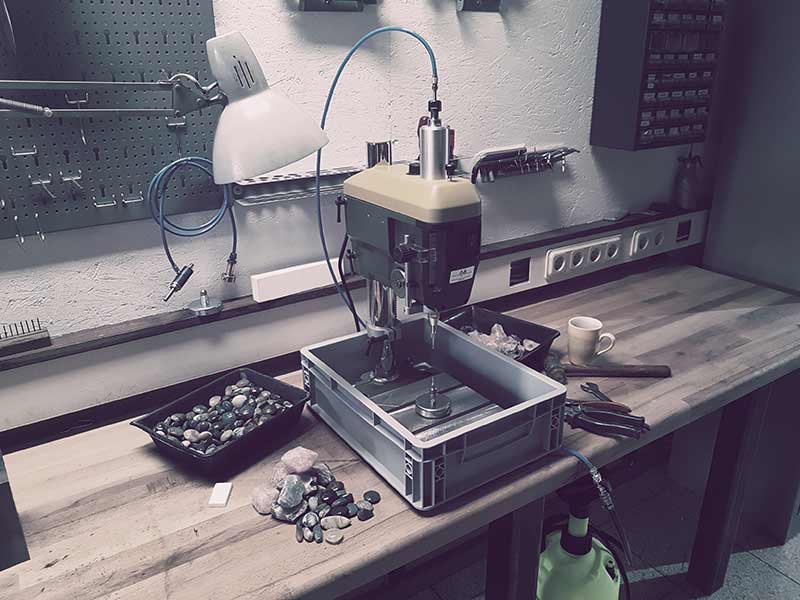
Yes! When you purchase a TBH Pro 3 diamond core drill or a bench drill with an adapter set, you receive a free training course. We'll familiarize you with the machine and the techniques of working with gemstone drills. The course takes place at our facilities in Idar-Oberstein by arrangement. This is an exclusive service that provides you with the ideal introduction to professional gemstone processing. You'll learn not only the technical operation but also the intricacies of tool selection, proper cooling and pressure, as well as tips for extending tool life.
Our diamond drill bits are suitable for a wide range of hard and brittle materials: gemstones (agate, jasper, rock crystal, amethyst, etc.), glass and crystal glass, technical ceramics, porcelain, stoneware, marble, granite, natural stone, composite materials, and even hardened metals. The key is choosing the right diamond grit and bond – we use harder bonds for softer materials and softer bonds for harder materials, ensuring the tool continuously self-sharpens. We would be happy to advise you on the optimal tool selection for your specific material.
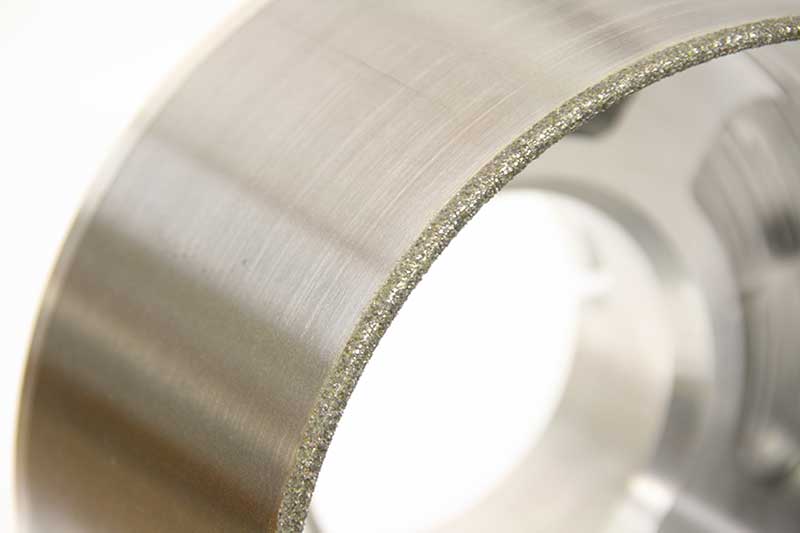
Hollow drill bits (also called core drill bits) have a tubular geometry with diamond coating only on the edge of the drill bit. They drill a ring-shaped cut, leaving a core in the center. This significantly reduces the cut surface, resulting in faster drilling, less wear, and less heat generation. Hollow drill bits are ideal for larger diameters from 6 mm and up, and for through holes. Solid drill bits, on the other hand, have a closed end face with diamond coating across the entire bore and remove all the material. They are used for smaller diameters, blind holes, or when the core is not desired. For most gemstone processing applications, we recommend hollow drill bits due to their superior efficiency.
Yes, water cooling is absolutely essential for hard and brittle materials! It fulfills three critical functions: First, it prevents the diamond grains from overheating, as they can lose their hardness or break out of their bond at excessively high temperatures. Second, it reduces thermal stresses in the workpiece that would lead to cracks or chipping – particularly critical with glass and gemstones. Third, it continuously flushes the drilling slurry from the kerf, ensuring the diamond grains always maintain free contact with the material. Without cooling, tool life drops to a fraction of its original value, and the scrap rate increases dramatically. For optimal results, we recommend a continuous water flow of at least 0.5 liters per minute directly at the drilling point.
The lifespan depends heavily on the material being processed, the application technique, and tool maintenance. With correct use, sufficient water cooling, and appropriate pressure, you can expect the following guideline values: In softer gemstones like agate or jasper, core drill bits achieve 500-1000 holes; in medium-hard glass, 300-500 holes; and in very hard materials like quartz or rock crystal, 150-300 holes per tool. Electroplated precision tools have a shorter service life due to the thinner bonding layer, but offer more precise cuts. Sintered tools with a multi-layered diamond coating last significantly longer. Important: Regular dressing and avoiding overheating can extend the service life by up to 60%. We also offer a re-coating service for worn tools.
The choice of adapter depends on your machine spindle and tool shank. We offer standard adapters for the most common mounts: M14 thread (common on angle grinders and hand drills), M10 thread, 1/2" gas thread, and various metric shaft mounts. Our precision adapters are made of hardened steel and ensure minimal runout for precise drilling. For our TBH Pro 3 bench drills, we offer complete adapter sets that cover all common tool shanks. If you have a special machine mount, we also manufacture custom adapters. Simply send us your machine's technical specifications – we'll advise you on the optimal adapter solution. The right adapter is crucial for a secure hold, precise operation, and a long tool life.
How long does delivery take and are the products in stock? Our standard range of diamond drill bits, core drill bits, and accessories is usually in stock and shipped within 2-3 business days of receiving payment. Within Germany, delivery then takes an additional 1-2 days, and to EU countries 3-5 days. Bench drills and adapter sets are also usually available from stock. For custom-made or customer-specific tools, the production time is approximately 2-4 weeks, depending on complexity and current order volume. For urgent projects, we also offer express production for an additional charge. After placing your order, you will receive an order confirmation with the estimated delivery date. For large orders or if you have questions about availability, please contact us in advance – we will check our current stock and reserve your items.
Absolutely! Custom manufacturing to customer specifications is our specialty. Whether you require specific diameters, unusual shank geometries, customized segment lengths, or special diamond grit sizes – we implement your requirements. The process begins with a technical consultation, during which we analyze your application, the material, and the desired drilling results. Based on this, we create a technical drawing and a quotation. After your approval, we manufacture the tool according to your exact specifications. Small batches or individual pieces are also possible. We develop tailor-made solutions, especially for industrial manufacturing processes, scientific applications, or specialized workshops. All custom tools are documented, so reorders with identical specifications are possible at any time. Contact us with your requirements – together we will develop the perfect tool.
Maintenance depends on the intensity of use. For daily use, we recommend basic maintenance every 6 months; for occasional use, once a year. Maintenance includes: cleaning the spindle bearings and removing drilling sludge, checking and, if necessary, adjusting the spindle bearings for precise concentricity, checking the belt tension or direct drive, lubricating moving parts (column, feed mechanism), checking the cooling water pump and lines, and checking all electrical connections. After intensive use, the drive belts and seals should also be checked. Our TBH Pro 3 is designed for low maintenance; however, regular servicing significantly extends its service life. We offer a maintenance service at our factory in Idar-Oberstein. During this service, your machine will be completely checked, adjusted, and returned with a test report. We also provide detailed instructions for simple maintenance tasks.
With a Mohs hardness of 10, industrial diamond is the hardest known material and offers unique physical properties for toolmaking. Its exceptional hardness enables the precise machining of even extremely hard materials such as technical ceramics, sapphire glass, cemented carbide, or fiber-reinforced composites. The combination of synthetic diamonds with various bonding systems—metallic bonding for sintered tools or electroplated nickel bonding for electroplated tools—creates an optimal balance between tool life and cutting performance. The grain structure, grain concentration, and grain size are precisely tailored to the specific material: fine grains for precise cuts in glass or ceramics, coarser grains for high material removal rates in concrete or natural stone. In addition, diamond offers excellent thermal conductivity, which reduces heat generation during the cutting process and prevents thermal damage to the workpiece. This combination of extreme hardness, optimized bonding, and precise grain matching makes diamond tools indispensable in precision manufacturing and industrial material processing.
Proper use and maintenance of your diamond tool can significantly extend its service life. For hard and brittle materials such as glass, ceramic, or porcelain stoneware, continuous water cooling is essential – it prevents the diamond grains from overheating, reduces thermal stress in the workpiece, and simultaneously flushes away the resulting debris from the kerf. The optimal contact pressure should be selected so that the tool operates consistently without slipping or jamming – excessive pressure leads to premature wear and can break the diamond grains out of the bond, while insufficient pressure causes the bond to polish instead of cut. The speed should be adjusted according to the tool diameter and the material being machined: higher speeds for small diameters and softer materials, lower speeds for large tools and hard materials. Regular dressing or sharpening of the diamond segments – for example, by briefly cutting in abrasive material such as sandstone – removes clogged bond layers and exposes fresh diamond grains. During extended periods of inactivity, tools should be stored in a dry, dust-free environment. Avoid abrupt load changes or lateral loads, as these can lead to chipping or cracking in the segments. These measures can increase tool life by 40-60%.
A worn diamond tool exhibits several characteristic signs that should be recognized early to prevent damage to the workpiece or machine. The clearest signal is a noticeable decrease in cutting performance: The drill bit penetrates the material more slowly, requires more pressure, or generates an unusually high amount of heat. When drilling into glass or ceramics, chipping increasingly occurs at the drill edge or on the exit side – a clear indication of dull or missing diamond grains. Uneven running, increased vibration, or a rough cutting surface also point to uneven wear. Visual inspection reveals wear as shiny, polished areas on the segments where the bond has completely covered the diamond grains. Deep grooves, chipped segments, or visible cracks are signs of critical wear, at which point the tool should no longer be used safely. We recommend having tools checked as soon as the first signs of performance loss appear. Our free inspection service analyzes the condition of your tools, and if sufficient segment height remains, we offer a re-tipping service where the segments are fitted with new diamond grit. This is significantly more cost-effective than buying new tools and is also sustainable, as the tool body is reused.
Absolutely – custom-made tools are one of our core competencies and constitute a significant portion of our production. Many industrial applications require tools with specific dimensions, special geometries, or adapted bonding systems that are not available in our standard product range. Our development team works closely with you to develop the optimal solution for your specific application. All parameters are taken into account: the material to be machined, the machine used, the desired surface quality, the required tool life, and the quantity. Based on these requirements, we jointly define the ideal diamond grit, the appropriate bonding system, the segment geometry, and the tool dimensions. Custom-made tools are feasible even for very small production runs – even single pieces can be manufactured economically if the application justifies it. After the design phase, we create technical drawings for approval and, if necessary, produce prototypes or samples for practical testing. The production time for custom tools is typically 2-4 weeks, depending on complexity and current workload. All custom-made tools are documented, making reordering straightforward. Contact our team with your requirements – we will be happy to advise you and develop the perfect tooling solution for your production.
FAQ-Bereich:
In unserem FAQ-Bereich finden Sie hilfreiche Informationen und Antworten auf häufig gestellte Fragen zu unseren Produkten und deren Anwendung. Hier erklären wir wichtige Grundlagen zu Diamantbohrern, Diamanthohlbohrern sowie zu weiteren Diamantwerkzeugen aus unserem Sortiment.
Unser Ziel ist es, Ihnen den bestmöglichen Überblick über unsere Werkzeuge, deren Einsatzmöglichkeiten und die richtige Anwendung zu geben. Egal ob Sie sich über Materialien, Bohrtechniken oder die Auswahl des passenden Werkzeugs informieren möchten – in diesem Bereich stellen wir Ihnen wertvolle Hinweise und praxisnahe Tipps zur Verfügung.
Sollten Sie weitere Fragen haben oder eine individuelle Beratung benötigen, steht Ihnen unser Team selbstverständlich gerne zur Seite.